Comparison of Unit Cell Lattice Structures Under Compression
ASU UG Honors Program Course SP 2022
Abstract: A unit cell is the smallest portion of a crystal lattice and contains the three-dimensional pattern of the entire crystal. The purpose of testing and analyzing various unit cell lattice structures under loading is their application to large-scale structures. Testing is performed to understand the specific properties of the lattice structure. By analyzing which properties cause a structure to deflect more elastically, withstand higher loads, or any combination of desirable properties, they can then be implemented into larger-scale designs. Another purpose is to understand the strength-to-relative density relationship of a structure. By modifying the relative density of a structure, the durability can be changed. However, there will be a point in which increasing the relative density further will no longer be beneficial to the design and will either be over-engineered or reduce elements of the structure designed to amplify different properties. By comparing these results on a unit cell basis, specific elements in the lattice structure design can be associated with specific properties. The testing and analysis of unit cell lattice structures under loading provide large-scale results on a small-scale budget and provide insight into broad-scale structural designs. The results of these tests show how different lattice structures amplify specific structural properties. The Edge structure withstood the highest loading force of 29.70 kN, but at the lowest displacement (before necking) of 2.02 mm. In contrast, the NPR Type B withstood a rather low loading force of 4.01 kN but was able to displace 3.71 mm (before necking).
- Funding: ASU UG Honors Program Course (3 credits)
- Collaborator:
- Student: Logan Drake
- Award Amount:
- Duration: SP 2022
Project Images
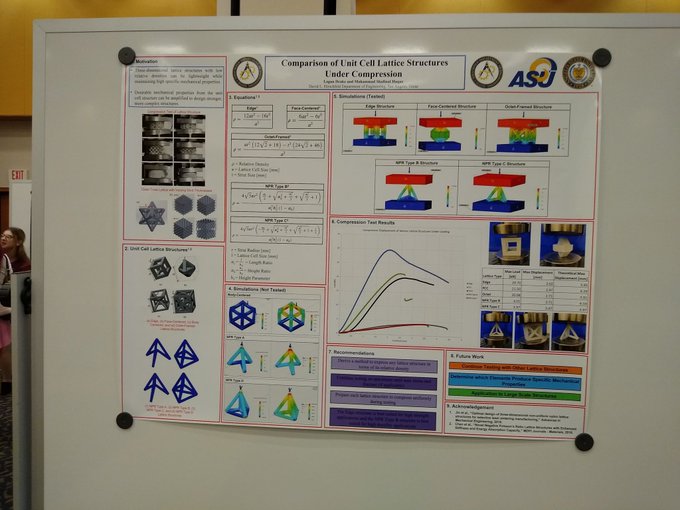
Poster
 </
</